
Uncategorized

video editor
Uncategorized

Content Marketing Tips That Drive More Leads and Sales

By muneershahid54@gmail.com / July 8, 2026 Introduction: Why Content Marketing Matters More Than Ever Content Marketing Strategies 2026: Content marketing has become one of the most powerful digital marketing strategies for businesses of all sizes. Instead of relying solely on traditional advertising, companies now create valuable, informative, and engaging content that attracts potential customers naturally. As a result, businesses can build trust, increase brand awareness, and generate qualified leads that are more likely to convert into paying customers. Furthermore, a well-planned content marketing strategy supports every stage of the customer journey. Whether your goal is to improve SEO, increase website traffic, strengthen customer engagement, or achieve consistent sales growth, high-quality content provides lasting value. Therefore, organizations that invest in content marketing gain a significant competitive advantage in today’s digital landscape. 1. Understanding the Power of Content Marketing Content marketing focuses on creating and distributing valuable information that solves customer problems and answers important questions. Unlike traditional advertising, content marketing educates, informs, and builds meaningful relationships before asking customers to make a purchase. Consequently, businesses earn trust rather than demanding attention.Moreover, effective content marketing supports long-term business growth. Every blog post, video, infographic, and social media update becomes a valuable digital asset that continues attracting visitors over time. As a result, companies experience improved lead generation, stronger customer loyalty, and increased conversions. 2.Define Clear Marketing Goals Before Creating Content Every successful content strategy begins with clearly defined objectives. Before creating content, determine whether your primary goal is increasing website traffic, generating qualified leads, improving SEO, boosting brand awareness, or increasing online sales. Clear objectives help you measure performance and refine your strategy over time.In addition, setting measurable goals allows your marketing team to stay focused. For example, you may aim to increase organic traffic by 30%, generate 100 qualified leads each month, or improve conversion rates within six months. These measurable targets create accountability while guiding every content decision. 3.Know Your Audience Before You Write Understanding your target audience is the foundation of successful digital marketing. Research customer demographics, interests, challenges, and purchasing behavior before creating content. Consequently, your articles become more relevant, useful, and engaging for potential customers.Furthermore, developing detailed buyer personas helps marketers produce personalized content. Instead of writing for everyone, you can address specific customer pain points with practical solutions. As a result, readers spend more time on your website and become more likely to trust your business. 4.Create High-Quality Content That Solves Real Problems Exceptional content always delivers genuine value. Instead of focusing only on promotional messages, provide practical advice, step-by-step tutorials, industry insights, and expert recommendations. Consequently, readers begin viewing your business as a trusted authority. Additionally, well-researched content improves both user experience and search engine rankings. When visitors find helpful information that answers their questions, they are more likely to share your content, subscribe to your newsletter, and return for future updates. 5.Optimize Every Article for SEO Search Engine Optimization (SEO) Even the best article cannot generate results if potential customers cannot find it. Therefore, optimize every page with relevant keywords, compelling meta descriptions, descriptive headings, and internal links. Moreover, search engines reward websites that consistently publish valuable and optimized content. Include keywords naturally throughout the article without excessive repetition. Additionally, optimize images, improve page speed, and ensure your website performs well on mobile devices to increase visibility in search results. 6.Diversify Your Content Formats Modern audiences consume information in different ways. While many readers enjoy detailed blog posts, others prefer videos, podcasts, infographics, or downloadable guides. Therefore, diversify your content formats to reach a broader audience and improve customer engagement.Furthermore, repurposing existing content saves time while maximizing value. For example, transform a blog post into social media graphics, a short video, or an email newsletter. Consequently, one piece of content can generate multiple opportunities for lead generation and audience growth. 7.Promote Your Content Across Multiple Channels Publishing content is only the beginning. To maximize results, distribute your articles through social media platforms, email newsletters, professional communities, and online forums. Consequently, your content reaches more potential customers beyond search engines.In addition, collaborate with industry experts and influencers whenever possible. Guest blogging and strategic partnerships increase credibility while expanding your audience. As a result, your business gains stronger brand awareness, additional backlinks, and higher website traffic. 8.Measure Performance and Continuously Improve Successful marketers regularly analyze content performance using analytics tools. Monitor important metrics such as page views, bounce rate, average session duration, keyword rankings, and conversions. These insights reveal which topics generate the strongest business results.Furthermore, continuous improvement should become part of your marketing process. Update outdated articles, improve underperforming pages, and optimize headlines based on user behavior. Consequently, your content remains relevant while maintaining strong search engine performance. 9.Convert Visitors into Loyal Customers Attracting visitors represents only one part of the marketing process. The ultimate goal is converting those visitors into loyal customers. Therefore, every article should include a clear and persuasive call to action that encourages readers to take the next step.Additionally, offer valuable resources such as free consultations, downloadable guides, newsletters, or exclusive content in exchange for contact information. These lead magnets strengthen lead generation while helping businesses build long-term customer relationships that support sustainable revenue growth. Conclusion: Build Long-Term Success Through Content Marketing Content marketing is not a short-term tactic but a long-term business investment. By consistently publishing valuable, optimized, and audience-focused content, businesses can improve SEO, increase website traffic, strengthen brand awareness, and generate qualified leads. Furthermore, strategic content builds trust that eventually leads to higher conversions and measurable sales growth. Ultimately, success depends on consistency, quality, and continuous improvement. Businesses that understand their audience, create valuable content, optimize for search engines, and analyze performance will remain competitive in an increasingly digital marketplace. Therefore, investing in a strong content strategy today will produce lasting benefits for years to come. Frequently Asked Questions 1.What is content marketing? Content marketing is the practice of creating and sharing valuable, relevant, and consistent content to attract and retain a clearly defined audience while driving profitable customer actions. 2.Why is SEO important for content marketing? SEO improves the visibility of your content in search engines, helping attract organic visitors who are actively
digital marketer website
Uncategorized

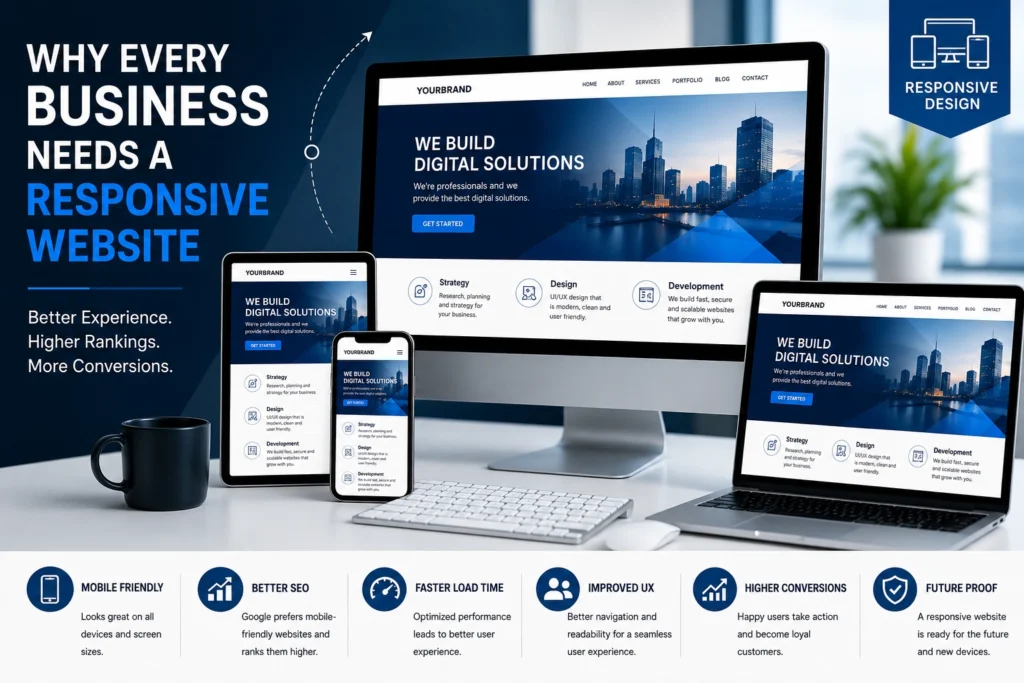
Why Every Business Needs a Responsive Website

By muneershahid54@gmail.com / July 10, 2026 Introduction: A Responsive Website Is No Longer Optional Importance of a Responsive Website in 2026: In today’s digital-first world, a business website serves as the foundation of an organization’s online presence. Customers expect websites to load quickly, display perfectly on every device, and provide a seamless browsing experience. Therefore, investing in a responsive website is no longer optional—it is a necessity for businesses that want to remain competitive and achieve sustainable growth. Furthermore, the rapid increase in mobile internet usage has transformed customer expectations. Whether users browse from smartphones, tablets, laptops, or desktop computers, they expect a consistent and user-friendly experience. A mobile-friendly website not only satisfies these expectations but also strengthens SEO, improves user experience, and increases conversions. Consequently, businesses that prioritize responsive web design gain a significant competitive advantage. 1.What Is a Responsive Website? A responsive website automatically adjusts its layout, images, and content to fit different screen sizes and devices. Instead of creating separate websites for desktop and mobile users, responsive web design uses flexible layouts and modern coding techniques to provide one consistent experience across all platforms. Moreover, responsive websites eliminate usability issues that often frustrate visitors. Buttons remain easy to click, text stays readable, and images resize appropriately. As a result, customers can navigate the website comfortably regardless of the device they use, leading to greater satisfaction and stronger engagement. 2.Improve User Experience Across Every Device An outstanding user experience is one of the greatest benefits of web design. Visitors expect fast loading pages, simple navigation, and attractive layouts. Therefore, businesses that deliver these experiences are more likely to keep visitors engaged and encourage them to explore additional pages. Furthermore, satisfied visitors tend to spend more time on a website and interact with more content. They are also more likely to trust the business behind the website. Consequently, improved user experience directly contributes to higher customer retention, stronger brand credibility, and increased sales opportunities. 3.Responsive Web Design Improves SEO Performance Search engines reward websites that provide excellent experiences for users. Consequently, SEO performance improves when businesses adopt responsive web design. Google prioritizes mobile-friendly websites because they deliver better usability and consistent content across all devices. Additionally, responsive websites eliminate duplicate content issues that may arise from maintaining separate desktop and mobile versions. A single website structure makes it easier for search engines to crawl and index pages efficiently. Therefore, businesses improve their Google ranking, attract more organic traffic, and strengthen their overall digital presence. 4. Mobile Users Continue to Dominate Internet Traffic The majority of internet users now browse websites through smartphones. Therefore, every business website must deliver an exceptional mobile experience to remain relevant. Customers frequently search for products, services, and local businesses while traveling, shopping, or relaxing at home. Moreover, mobile users expect immediate access to information. Slow-loading pages or poorly designed interfaces often cause visitors to leave within seconds. Consequently, businesses that optimize for mobile devices capture more opportunities and reduce the risk of losing potential customers to competitors. This highlights the Importance of a Responsive Website in 2026, helping businesses improve search engine rankings, enhance customer satisfaction, and achieve long-term online success. 5.Faster Website Speed Increases Customer Satisfaction Website speed plays a critical role in both user experience and business performance. Visitors appreciate websites that load quickly because they save time and provide immediate access to valuable information. Therefore, optimizing speed should be a priority for every business.Furthermore, faster websites experience lower bounce rates and higher engagement levels. Search engines also consider page speed as an important ranking factor. Consequently, improving website speed contributes to better SEO, stronger customer satisfaction, and increased conversion rates. 6.Build Trust and Strengthen Brand Credibility A professionally designed responsive website reflects the quality and reliability of a business. Customers often judge a company within seconds of visiting its website. Therefore, an attractive, organized, and easy-to-use website creates a positive first impression.In addition, consistent branding across every device reinforces professionalism. Whether customers browse on mobile phones or desktop computers, they experience the same design, messaging, and functionality. As a result, businesses establish greater trust, improve customer confidence, and encourage repeat visits. 7.Increase Conversions and Generate More Leads The primary objective of most business websites is to convert visitors into customers. A responsive website simplifies this process by providing clear navigation, accessible contact forms, and straightforward purchasing options. Consequently, visitors complete desired actions more easily.Moreover, businesses can optimize calls to action for every screen size without sacrificing usability. Whether customers request a quotation, subscribe to a newsletter, or complete an online purchase, responsive design removes unnecessary barriers. Therefore, companies generate more qualified leads and achieve higher conversion rates. 8.Support Your Digital Marketing Strategy Every successful digital marketing campaign depends on a high-performing website. Whether businesses invest in SEO, social media marketing, email campaigns, or paid advertising, all traffic eventually reaches the company website. Furthermore, responsive websites improve campaign performance by providing consistent experiences for every visitor. Marketing investments produce better returns because users remain engaged instead of leaving due to poor usability. Consequently, businesses maximize their advertising budgets while improving customer acquisition. 9.Prepare Your Business for Future Growth Technology continues to evolve rapidly, and customer expectations continue to increase. Therefore, businesses should invest in solutions that remain effective for years to come. Responsive web design provides the flexibility needed to adapt to new devices and changing digital trends.Additionally, maintaining one responsive website is more efficient than managing multiple versions for different devices. Businesses reduce maintenance costs, simplify updates, and improve operational efficiency. As a result, organizations remain competitive while focusing more resources on innovation and growth. Conclusion: Invest in a Responsive Website for Long-Term Success A responsive website is one of the most valuable investments any modern business can make. It improves user experience, strengthens SEO, increases website speed, supports digital marketing, and enhances Google ranking. Furthermore, responsive web design builds customer trust while creating more opportunities for lead generation and business growth. Ultimately, businesses that prioritize responsive design position themselves for long-term success in an increasingly competitive marketplace. By delivering fast, mobile-friendly, and user-focused experiences, organizations attract more visitors, convert more customers, and establish a strong

Common Digital Marketing Mistakes
Uncategorized

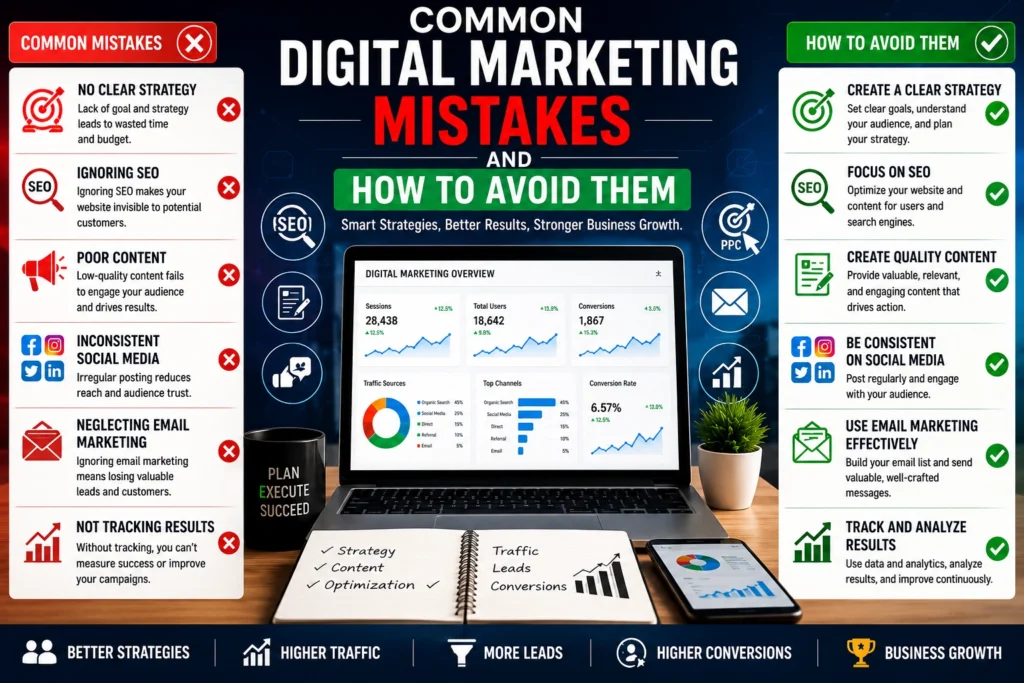
Common Digital Marketing Mistakes and How to Avoid Them | Complete Guide

Introduction: Why Avoiding Digital Marketing Mistakes Matters Digital marketing has become one of the most effective ways for businesses to reach their target audience, build brand awareness, and increase revenue. However, many businesses fail to achieve their goals because they make avoidable mistakes that reduce their marketing effectiveness. Whether you are a startup, small business, or established organization, understanding these common pitfalls is essential for creating successful campaigns. Therefore, businesses must continuously adapt their strategies while avoiding practices that negatively affect performance. This guide explains the most common digital marketing mistakes and provides practical solutions to help you improve your digital marketing, strengthen SEO, increase website traffic, improve lead generation, and maximize conversions. 1. Starting Without a Clear Digital Marketing Strategy One of the biggest mistakes businesses make is launching marketing campaigns without a well-defined strategy. Many companies publish content, run advertisements, and post on social media without setting measurable objectives. As a result, their efforts become inconsistent, and they struggle to measure success. Instead, businesses should develop a comprehensive marketing plan before investing time and money. Define your target audience, marketing goals, preferred channels, budget, and key performance indicators. Consequently, every campaign supports your business objectives while producing measurable results. 2. Ignoring Search Engine Optimization (SEO) Many businesses create excellent content but fail to optimize it for search engines. Without proper SEO, even high-quality content may never reach its intended audience. Consequently, businesses lose valuable opportunities to generate organic traffic and qualified leads. To avoid this mistake, perform keyword research before creating content. Optimize page titles, meta descriptions, headings, images, and internal links while naturally incorporating relevant keywords. Furthermore, publish valuable content consistently to improve your website’s authority and search engine rankings. 3. Publishing Low-Quality or Inconsistent Content Content remains the foundation of successful content marketing. Unfortunately, many businesses publish content only occasionally or prioritize quantity over quality. Consequently, audiences lose interest, and search engines reduce the website’s visibility. Instead, create informative, engaging, and original content that addresses customer questions and solves real problems. Develop a content calendar to maintain consistency and ensure every article provides genuine value. As a result, your audience will trust your expertise and return for additional information. 4. Failing to Understand the Target Audience One of the most Common Digital Marketing Mistakes is failing to understand customer needs, preferences, and behaviors. However, many businesses create generic campaigns that try to appeal to everyone instead of focusing on specific customer segments. Consequently, marketing messages become less relevant and generate fewer conversions. To avoid these Common Digital Marketing Mistakes, conduct market research, analyze customer data, and develop detailed buyer personas. Additionally, monitor customer feedback to understand changing expectations. Therefore, your marketing campaigns become more personalized, engaging, and effective, helping your business achieve better results. 5. Neglecting Social Media Marketing Social media platforms provide valuable opportunities to connect directly with customers. Nevertheless, some businesses either ignore social media completely or post inconsistent and overly promotional content. As a result, they miss opportunities to build relationships and increase brand awareness.Instead, create a balanced social media strategy that combines educational, entertaining, and promotional content. Engage with followers by responding to comments, answering questions, and encouraging discussions. Consequently, your business develops stronger customer relationships and greater online visibility. 6. Ignoring Mobile Users and Website Performance Today, most internet users browse websites using smartphones. Therefore, businesses that ignore mobile optimization risk losing a significant portion of their audience. Slow loading times, poor navigation, and unresponsive layouts often cause visitors to leave immediately.Ensure your website uses responsive design and delivers an excellent user experience across every device. Furthermore, optimize website speed by compressing images, reducing unnecessary scripts, and improving server performance. Consequently, visitors remain engaged while search engines reward your website with better rankings. 7. Running Advertising Campaigns Without Proper Optimization Paid advertising can generate excellent results when managed correctly. However, businesses frequently launch campaigns without testing different audiences, headlines, or calls to action. Consequently, advertising budgets become inefficient, and return on investment decreases.Instead, continuously monitor campaign performance and perform A/B testing. Analyze click-through rates, conversion rates, and customer behavior before making adjustments. As a result, your advertising campaigns become more efficient while producing higher-quality leads. 8. Failing to Measure Marketing Performance Many businesses invest heavily in marketing but rarely evaluate the results. Without performance analysis, organizations cannot identify successful strategies or recognize areas requiring improvement. Consequently, ineffective campaigns continue consuming valuable resources.Use analytics tools such as Google Analytics and social media insights to monitor important metrics. Track website traffic, bounce rates, conversion rates, customer engagement, and return on investment. Furthermore, review these reports regularly to refine your marketing strategy and improve long-term performance. 9. Forgetting Strong Calls to Action Even informative content may fail to generate results if readers do not know what action to take next. Many businesses overlook the importance of clear calls to action, leaving visitors without guidance. Consequently, valuable opportunities for lead generation disappear.Every blog post, landing page, and advertisement should include a compelling call to action. Encourage visitors to subscribe to newsletters, request consultations, download resources, or contact your business. Therefore, your marketing efforts produce measurable business outcomes instead of simply generating website visits. 10. Embracing Continuous Improvement Search engine algorithms, consumer preferences, and technology continue to evolve. Therefore, businesses that refuse to adapt often experience declining performance over time. Develop a culture of continuous learning and improvement. Stay informed about industry trends, attend professional training, and regularly update your marketing strategies. Consequently, your business remains competitive while consistently delivering better customer experiences. Conclusion: Build Success by Avoiding Common Mistakes Avoiding Common Digital Marketing Mistakes is essential for achieving sustainable online growth. Businesses that invest in SEO, create valuable content marketing strategies, optimize websites for mobile users, understand their target audience, and measure campaign performance consistently outperform competitors. By identifying and avoiding Common Digital Marketing Mistakes, businesses can improve lead generation, increase website traffic, and achieve higher conversion rates. Ultimately, success in digital marketing requires careful planning, consistent execution, and continuous improvement. Learning from Common

Scroll to Top